Announcing the Above Ground Blog Tour!

To celebrate the release of my first novel, I’m organising a month-long blog tour.

From November 1st to 30th, there will be prizes and fun times, plus guest posts, interviews, excerpts, short stories, reviews, and anything else you can dream up.

This is where YOU come in. I want to get a blog tour slot for every single day. Do you run a blog? Do you want to join the fun and earn my undying gratitude?

Fill in the form below with your availabilities and what type of post you’d like to run, or email me at annamharte [at] gmail [dot] com.

Above Ground: the end is nigh!

With only 3 more chapters to go until the end of _Above Ground_, I am neck-deep in getting the story ready for print/ebook release.

Yes, there are revisions… even though what is now posted online is supposed to be the rewrite. I’m silly, I know. Most of the changes smooth out scenes, fix timelines and little plot holes. I’ve reworked the first chapter, and will also do whatever my lovely editor, Terra Whiteman, orders me to do. (If you haven’t read Terra’s series, The Antithesis, it’s awesome.)

So I wanted to take a moment and say thank you to my qazyfiction fans, especially those who’ve followed me from the very beginning. This story wouldn’t exist without you.

Which brings me to:

Everyone who has commented, supported me, and been generally lovely is going on the acknowledgements page. If you have a preferred internet handle/name, let me know. Otherwise I’ll go with the name I know you by. :-) (And if you don’t want to be included, let me know too. But it’ll make me sad.)

Regarding the print/ebook release:

  • Estimated publication date is mid-end of October.
  • On October 1st, I will reveal the cover and a special offer to pre-order ebook/print copies to my mailing list only. The ebooks will be signed. Pre-orders will be limited; sign up so you don’t miss out.
  • I haven’t announced this anywhere else yet, but I’ll be running a blog tour throughout November. If any of you have active blogs and want to take part, fill in this form — you’ve got first dibs on dates!
  • If you want to stay on top of the latest news, I’ll be posting about it more on amharte.com, facebook and twitter.

As for sequels to _Above Ground_… One book at a time, eh? ;-)

Eleven Rules For Editing Fiction

So you’ve nailed down the 11 Rules for Writing Fiction. You’ve finished your novel. You feel good. INVINCIBLE. But then… what’s that? A typo? A cliché?!

Crap, you realise. The hard work has only just begun.

Welcome to the world of editing.

No, come back! Don’t run away screaming! Editing is fun. It’s like scrubbing off the dirt from your novel’s little face. You know how good it feels when you scrub your kitchen until all the surfaces are sparkly? That’s what editing is like.

But where do you start? Here’s some suggestions on what to look out for….

11 Rules For Editing Fiction

  1. Read critically.
    Take a break from your novel and come back to it with fresh eyes. Read it critically. Find out where things don’t work and what you need to change. Take notes.

  2. Plan.
    You don’t want to edit the story any more than you have to. Look over your notes, and if needed write a new outline. How will you better demonstrate the character’s development? Where will you plant clues about the killer’s identity? Know what needs to be changed and how, before you start rewriting.

  3. Leave line editing for last.
    The story’s basic structure comes first; leave the details for last. Focus on fixing plot holes first, on re-ordering scenes, fixing timelines–the big stuff. Don’t waste time on making a sentence sound perfect, when you don’t even know whether that scene will survive the rewrite.

  4. CUT! (aka Know When To Start)
    Get rid of that prologue. Heck, get rid of the first two chapters. Cut straight to the action–the readers don’t need long passages introducing the protagonist, the protagonist’s family and the protagonist’s collection of rocks. Neither do they need weather reports or waking-up-in-bed starts. Speaking of which…

  5. Avoid bedtimes.
    Don’t abuse waking and sleeping. If that’s how you do all your scene breaks, something’s wrong — even if your protagonist is narcoleptic. Finishing a scene with someone drifting off to sleep is often anti-climatic, starting with them waking in bed is dull, and you can only believably wake up from a nightmare so many times.

  6. Avoid cliché.
    Both in your scenes and in your language. Pay special attention to similes and metaphors–as black as night, as cold as death, a bird in the hand… To make your story sound original and fresh, get rid of anything your reader will recognise.

  7. Delete unnecessary words.
    Make your writing as tight as possible. Often-overused offenders are: seem, suddenly, just, even, really, feel, almost, slightly, and directional words (up/down/in/out). Treat adverbs with caution. Cut as many as possible.

  8. Get an outside opinion.
    Have other people read it. Develop a thick skin. Listen to all of their advice and thank them for it. Compile their feedback, and see what they all agree on.

  9. Read it aloud.
    Listen to the rhythm. Does it sound right?

  10. Love what you do.
    Don’t despair. Editing can be disheartening, but it’s not all bad. And hey, even if it is, that’s why you’re editing!

  11. Finally…
    Share your wisdom — what’s your eleventh editing rule?

Above Ground Cover: Sneak Peek!

In Book Cover Design: Dos and Don’ts, I showcased my own amateur Above Ground covers as a prime example of why it’s better to get a professional on board.

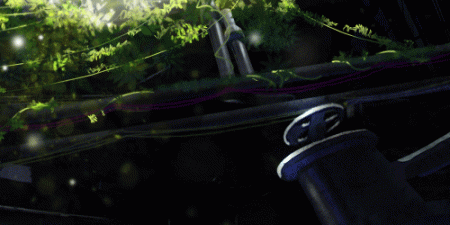
Thanks to 1889 Labs, I’ve bagged an awesome illustrator. Jeffrey has brought my cover to life with some stunning artwork… so today I’m sharing a teaser of his work.

Below is one TINY section of the new Above Ground cover — the bottom right corner.

On October 1, I’ll reveal the FULL cover to my mailing list, plus offer subscribers the chance to pre-order copies. Don’t miss out: sign up now.

Woo!

Book Cover Design: Dos and Don’ts

In indie publishing, you have two choices: either you do the cover yourself, or you don’t.

Unless you are a professional graphic designer, I strongly recommend the latter. Your book cover is the your main marketing tool, second in importance only to having a solid, well-edited story — mess it up, and you’ll hurt your sales.

1. Don’t: Think you can do it alone (unless you actually can).

These are two of the rough Above Ground covers that I made over the last 3+ years.

While I’ve never used them to SELL the book, it’s clear that these covers wouldn’t help sales. I’m not an artist or even a Photoshop expert; my attempts are amateur and reflect badly on my writing.

Just because it’s indie publishing doesn’t mean it’s okay to look homemade. Your book is competing against countless other indie and trade titles. Every detail matters.

2. Do: Stick to what you’re good at.

Most of us are writers, not artists — and even those of us artistically inclined may not have the eye for design. Book covers require more than just good illustrations. There is typesetting and layout to consider; the writing should blend with the image.

Did you see those covers I made? Yep, I’m sticking to writing.

3. Don’t: Settle for anything you dislike.

If you wanted a cover image forced upon you, you should have taken the traditional route.

As an indie we’re free to get what we want (within budget and reason). A good illustrator or designer — like the lovely Jeffrey Thompson who is illustrating Above Ground — will create mock-up covers for you to choose from, will tweak things, listen to your feedback, and work with you to make you happy. With Hungry For You, I rejected the cover 8 times before MCM and I found the perfect fit.

If you settle for anything less, you’ll hate your book.

4. Do: Spend time thinking about what you really want.

I made rough sketches, and finally pitched Jeffrey with two ideas. I described the viewpoint, the surroundings, the feel of the cover, the colours… I told him about the book itself, too. The more you explain, the easier it is for them to understand where you’re coming from.

5. Don’t: Ignore market trends.

Check out bestsellers in your genre. Are there trends in the cover design? Similar fonts, colours, types of images? These are all subtle markers which readers pick up on.

Yes, you want your book cover to be original, but you ALSO want readers to roughly know what the book is about by simply glancing at the cover. With the right colours and style, you’ll lure in your target audience, and warn away any haters.

In sum: if you’re writing horror, don’t use a pink theme with fluffy cupcakes and high heels. Unless there’s lots of blood too.

6. Do: Consider your format.

If most of your sales will be ebook sales and most of your marketing will be online, your book cover needs to look good even as a thumbnail. Shrink down your book cover. Is is still appealing, legible, eye-catching? Does it still convey the book’s genre?

Keep in mind that some ereaders only have black and white displays. Does your cover have sufficient contrast; would it look okay without colour?

When it comes to print publishing, you may have to pick paper type (matt or gloss) and also decide what to put on your spine and back cover. If in doubt, look to others for inspiration; I pulled down all the print books on my shelf and studied EVERYTHING — colours, fonts, text alignment, content, layout….

7. Don’t: Break the bank.

Be realistic about how much you can afford to spend. Book covers can be expensive, and while it’s worth investing in a good cover, there’s no point in making yourself go hungry. If you can’t afford a professional, negotiate with or beg your more artistically-inclined friends for help. Alternatively, find a designer just starting out who is looking to build up their portfolio; they might be willing to handle the work for a reduced (or free) rate.

8. Do: Break the rules.

I said it right at the start of this post: I’m no expert. I’m sure some of you could break every single rule above and create an awesome book cover.

What are your dos and don’ts for book cover design?

And for those of you with book covers already, which one makes you proudest?