6 Lessons Learnt From Writing My Second Novel

Writing Above Ground took four drafts, five different outlines, and several years.

But when I published it I thought: that’s it.

I’ve done it once, so I can do it again — and now that I’ve learnt 6 lessons from my first novel, the second time will be easier. Faster.

I was wrong.

For the last year, I’ve spent hours toiling away at Darksight. It’s the reason why I’ve been rubbish at blogging (and tweeting, and facebooking…). I wanted to finish the novel by August 2015. Then August came around, and I pushed the deadline to December. And now, mid-January, I’m still not done.

Sure, what I found difficult the first time is easier today.

But I’ve stumbled across a whole new can of worms…

So here is a revised list of lessons learnt from writing novels:

Lessons Learnt From Writing My Second Novel

  1. The first time’s the hardest — or is it?
    When writing my first novel, I didn’t know whether I could finish a novel. But I also didn’t have the pressure to outperform my previous work. In some respects, it’s more frustrating now that I know I can do it, yet am struggling regardless.

  2. Perseverance is key — and it’s harder alone
    The webfiction community helped me push on through the first draft of Above Ground, with no time to agonise over each chapter. With Darksight, I’ve opted to write it all offline — and realised how much harder it is without the community support (and pressure to post).

  3. It’ll never be perfect — but when should you stop?
    I rewrote Above Ground countless times, watching my writing style develop, thinking it would be perfect the next time. I have rewritten and edited Darksight much less, mostly because I’ve taken a lot more time to get it right the first time. I’m not sure which method is worse: in either case, I need to remember to let go.

  4. Outline, outline, outline — in moderation
    I pantsed Above Ground. The first draft was a mess, and I swore never to put myself through that again. With Darksight, after the initial splurge I sat down and outlined the entire novel. I tried different outlining techniques and layouts, used index cards and excel sheets, tables in Word and bullet point lists. I have barely had to rewrite or edit, but have I outlined the life out of the story?

  5. You get better at it — kind of
    Plot construction, pacing, character development? I get it. Being able to write a novel quickly without running into writer’s block, whilst juggling work and social commitments? On this front, I still have much to learn.

  6. You never stop learning
    And you’ll always want to be a better writer than you are today. Just don’t forget to look back now and then, and recognise how far you’ve come.

I’ll keep you updated on my progress…
Blog Tour: Beyond The Wail

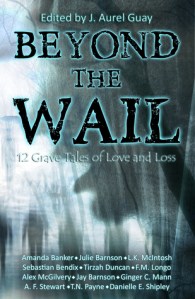
BeyondTheWail What is it about fear and the unknown that pulls so passionately at the human heart? Perhaps we are drawn not to the darkness itself, but to the resolution, the overcoming of what we most deeply dread. After all, the more terrible the struggle, the greater the victory when it comes at last. Presented in this anthology are twelve remarkable stories of the darkness that overshadows us, and the resolution that may be found beyond them. They are stories of fear and oppression, but ultimately stories of hope, stories that will take you BEYOND THE WAIL.

Everyone, meet Tirzah Duncan: NaNoWriMo enthusiast, headgear-wearer and knife-fighting-expert.

Tirzah Duncan is one of the 12 authors featured in the brand new BEYOND THE WAIL anthology. OF MICE AND MONSTERS, Tirzah’s contribution, follows Benjamin, whose attempts to help his timid girlfriend are impeded by his inner demons… and a ghost from his violent past.

Today, she’s kindly stopped by my blog to answer a few questions.

Did I mention there are PRIZES?

Tirzah, how did you come up with the concept of your short story?

There is a man who twists the necks of caged mice.” The first sentence popped into my head, and it drew me on from there, one sentence, one paragraph at a time. The heavy pall of darkness fascinated me, filled me with fear, but also with hope. I wrote without knowing where the story would go, without even knowing what the next sentence would be before I wrote it.

This is the only story I’ve written longhand in a notebook, the only story I’ve ever written quite like this. The only story I never had to force myself to keep writing, because it sank in its hooks and called me on, word by word.

Tell us a dark secret about your story.

The moment Benjamin slams down the glove, scaring his pet mouse? The moment the creature cowers, and he feels that rush of power go to his head?

I had that same moment in my childhood, with one of my rats. I felt the rush, and, even as an eight/nine-year-old, it frightened me. I could feel the darkness in it, the monstrosity, and I never did it again. But I remembered.

That is, fortunately, the only part of this work which is in any way autobiographic.

When did you know you wanted to be a writer?

When it was misery and I still loved it.

Name one entity that you feel supported your writing, outside of family members.

I’ve gotta give credit to two: Danielle Shipley, and Syawn Birk. One is my bestie, and I’m on the phone with her way too near to 24/7. Our characters party, talk, bond, and fight together just as much as we do. Somehow, we both manage to get a lot of writing done anyhow, her more than me.

Sy, though, is muse and main character, life coach and captain, friend and priest. He’s almost always at my side when I need inspiration or advice, a confessional or a sermon. I’ve loved him, I’ve hated him, I’ve wrestled over plot points with him, and I don’t know where I’d be without him.

What’s up next for you?

I’m creating an anthology of my own works, as it happens. Not sure what I’m going to call it yet, but I believe Danielle suggested “Tirzah tries to write love stories and fails pretty badly”.

The tales vary from urban fantasy to myth, swords-and-sorcery to psycho-punk, but they’re all centered around love.

In and among internal conflicts, passion, murder, magic, and good old-fashioned vigilantism, each story seeks to question what love really is, what it does, and what, in love, is most important.

Also, Death meets Santa Claus.

Tirzah Duncan Find out more about Tirzah on twitter or facebook. More information about the other stories included in BEYOND THE WAIL can be found on Goodreads.

ENTER THE BEYOND THE WAIL GIVEAWAY NOW!


Beyond The Wail

Saturday 10th October | Featured author: Danielle E. Shipley
Are you Afraid of the Dark?
John’s Writing
Spreading the Writer’s Word

Sunday 11th October | Featured author: Alex McGilvery
Ash Krafton: Emotion Between the Lines
Scott E. Tarbet, Author
Writer’s Law of Motion

Monday 12th October | Featured author: T.N. PAYNE
Melissa McShane, Author
Sarah’s Secret Stash
Notes from Author Ginger C. Mann

Tuesday 13th October | Featured Author: Ginger C. Mann
L.K. McIntosh
J S Brown
Fairies & Pirates

Wednesday 14th October | Featured author: L.K. McIntosh
Rampant Games
Scotty Watty Doodle All The Day
Terra Luft — View From the Crystal Ball

Thursday 15th October | Featured author: Jay Barnson
A Storyteller’s Journey
Creativity from Chaos
Christine Haggerty

Friday 16th October | Featured author: A. F. Stewart
Tales by Julie
Perpetual Chaos of a Wandering Mind

Saturday 17th October | Featured author: Amanda Banker
Sebastian Bendix
Alex Campbell
Semi Short chic

Sunday 18th October | Featured author: Julie Barnson
The Ink Caster
The Road to Nowhere

Monday 19th October | Featured author: Sebastian Bendix
The J. Aurel Guay Archive
:DandiFluff…

Tuesday 20th October | Featured author: Tirzah Duncan
Alex McGilvery’s World
A.M.Harte

Wednesday 21st October | Featured author: F.M. Longo
Ever On Word
The Cult of Me

THE BOILER IDENTITY: PART TWO

(Read part one first if you haven’t yet!)

With no money, memory, or shoes, Steve had no choice: he went to the bank.

As soon as the cold glass doors slid shut behind him he knew it was a mistake.

He hesitated on the threshold, crumpling the cheque in his hand. One thousand pounds. It would see him through the next couple of weeks while he tried to remember who he was. Whatever crime he had committed to earn the money didn’t matter for now… right?

Before he could change his mind, Steve joined the queue. When it was his turn, he slid the cheque onto the counter with a mumbled apology.

“I’m sorry, sir,” the teller said. He was tall and thin, aggravatingly cheery behind the layers of bullet-proof glass. The font on his name badge was intentionally small. “We need proof of ID to cash your cheque.

“And shoes,” he added pointedly, peering over the counter at Steve’s feet. “Health and safety regulations, you see.”

The queue behind Steve was growing, members of the general public leaning in to eavesdrop.

“But I’ve been mugged,” Steve lied, pushing the cheque against the glass. “They took everything!”

“I can call the police if you want…?” The teller’s eyebrow lifted as if he were contemplating calling the police regardless of Steve’s answer.

Steve shook his head, backing out of the queue. He stood outside in the weak sunshine, woollen socks sticking to the pavement, and wondered what his life was coming to.

By the time he retraced his steps to the house he’d woken up in, Steve was resigned to being arrested. The flashing blue lights ricocheted down the street, luring him to the scene of the crime.

Despite his resolve, Steve’s footsteps slowed when he spotted not one but two police cars–and an ambulance. Who had he hurt? Were they still alive?

A small woman with a blanket around her shoulders was standing at the front door, talking to the police, her red hair shimmering in the daylight. When she saw Steve, all colour fled from her face, as she lifted a shaky hand to point.

“There he is,” she said shakily.

Steve didn’t even bother to run. There was nowhere to run to anyway.

THE BOILER IDENTITY: PART ONE

Steven Borne woke up in a puddle.   
   
He didn’t know his name was Steve, not until he sat up and whacked his head on the bathroom sink. As he slipped across the tiles, away from that dangerous curve of porcelain, his hand brushed against a piece of paper in his pocket. It was a cheque, and when he unfolded it he saw the name: Steven Borne.
   
(What if the cheque wasn’t his? The possibility didn’t bear consideration; his memory loss was frightening enough. Besides, he felt like a Steve. It was a good name. Dependable.)
   
The bathroom was cold, quiet. It had high, cobwebbed ceilings and tall sash windows that needed refitting. A spiderweb of cracks in the paintwork. Whoever lived here either rented or was too lazy for DIY. 
   
The built-in cupboard next to the sink was half-open, revealing a combo boiler yellowed with age, the pressure valve leaking steadily. He stood — gingerly, hand against his head — and patted himself down for other clues. His pockets were empty but one of his hands was streaked with dark red stains.

Drip. Drip. Drip.

The cheque was for one thousand pounds. The handwriting was all in block capitals, angular and aggressive. Steve stared, wondered what he had been paid to do. Felt a cold sweat trickle down the back of his neck.

That’s when he saw it: a knife on the floor, spattered with blood.

Drip. Drip. Drip.

Steve looked at his hand again, then straightened to look into the mirror. There were more red streaks along his neck.

He followed the trail of blood spatters to the bathroom door, wincing with every step, his head thrumming with pain. At the threshold he paused, leaning against the cold, cracked tiles to catch his breath.

The blood spatters led down a narrow, tall corridor with parquet flooring and an ornate Victorian ceiling rose above the light fitting. Shame it had been painted over so clumsily.

He lurched down the corridor, one hand against the wall, his woollen socks slipping across the polished floor. The radiator gurgled in warning as he passed.

The trail finished at an archway near the front door. Steve stepped over the blood and peered into the room beyond.

It was a kitchen. Pieces of broken glass littered the floor. Blood dripped down to the counter.

Steve did the only thing he could: he fled.

To be continued…

My Writing Workspace

Where do you write?

After 9 years of living in London — and 8 house moves — I’ve learned to adapt quickly to new environments.

I have never had the luxury of a dedicated writing nook, but all my writing spaces have had three things in common: silence, solitude, and proximity to home comforts.

I’m not one of these coffee shop or library types. I need to be at home with both laptop and notebook — but where at home depends on my mood and needs.

If I’m not home alone, I write in my bedroom. It’s the one place where solitude is guaranteed, even if it’s not the most comfortable. I alternate between sitting on my bed and — when the urge to have a nap kicks in — on the floor.

In one of my previous houses I used to switch between writing on the floor in the kitchen (to enjoy the view of the garden) and the living room leather sofa (when I felt lazy).

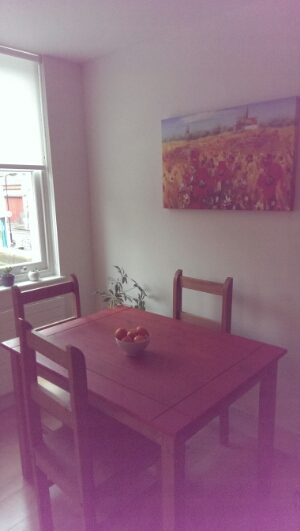
But in my current place I have a TABLE.

Check it out:

image

My writing space

Where do you write?

Does your writing nook needs some TLC? Check out these tips on how to create an inspirational workspace.