Above Ground Cover: Sneak Peek!

In Book Cover Design: Dos and Don’ts, I showcased my own amateur Above Ground covers as a prime example of why it’s better to get a professional on board.

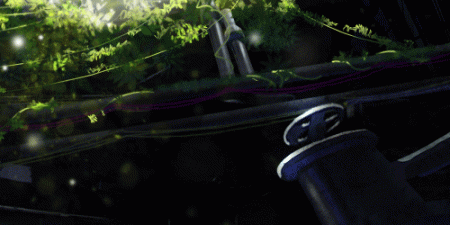
Thanks to 1889 Labs, I’ve bagged an awesome illustrator. Jeffrey has brought my cover to life with some stunning artwork… so today I’m sharing a teaser of his work.

Below is one TINY section of the new Above Ground cover — the bottom right corner.

On October 1, I’ll reveal the FULL cover to my mailing list, plus offer subscribers the chance to pre-order copies. Don’t miss out: sign up now.

Woo!

Book Cover Design: Dos and Don’ts

In indie publishing, you have two choices: either you do the cover yourself, or you don’t.

Unless you are a professional graphic designer, I strongly recommend the latter. Your book cover is the your main marketing tool, second in importance only to having a solid, well-edited story — mess it up, and you’ll hurt your sales.

1. Don’t: Think you can do it alone (unless you actually can).

These are two of the rough Above Ground covers that I made over the last 3+ years.

While I’ve never used them to SELL the book, it’s clear that these covers wouldn’t help sales. I’m not an artist or even a Photoshop expert; my attempts are amateur and reflect badly on my writing.

Just because it’s indie publishing doesn’t mean it’s okay to look homemade. Your book is competing against countless other indie and trade titles. Every detail matters.

2. Do: Stick to what you’re good at.

Most of us are writers, not artists — and even those of us artistically inclined may not have the eye for design. Book covers require more than just good illustrations. There is typesetting and layout to consider; the writing should blend with the image.

Did you see those covers I made? Yep, I’m sticking to writing.

3. Don’t: Settle for anything you dislike.

If you wanted a cover image forced upon you, you should have taken the traditional route.

As an indie we’re free to get what we want (within budget and reason). A good illustrator or designer — like the lovely Jeffrey Thompson who is illustrating Above Ground — will create mock-up covers for you to choose from, will tweak things, listen to your feedback, and work with you to make you happy. With Hungry For You, I rejected the cover 8 times before MCM and I found the perfect fit.

If you settle for anything less, you’ll hate your book.

4. Do: Spend time thinking about what you really want.

I made rough sketches, and finally pitched Jeffrey with two ideas. I described the viewpoint, the surroundings, the feel of the cover, the colours… I told him about the book itself, too. The more you explain, the easier it is for them to understand where you’re coming from.

5. Don’t: Ignore market trends.

Check out bestsellers in your genre. Are there trends in the cover design? Similar fonts, colours, types of images? These are all subtle markers which readers pick up on.

Yes, you want your book cover to be original, but you ALSO want readers to roughly know what the book is about by simply glancing at the cover. With the right colours and style, you’ll lure in your target audience, and warn away any haters.

In sum: if you’re writing horror, don’t use a pink theme with fluffy cupcakes and high heels. Unless there’s lots of blood too.

6. Do: Consider your format.

If most of your sales will be ebook sales and most of your marketing will be online, your book cover needs to look good even as a thumbnail. Shrink down your book cover. Is is still appealing, legible, eye-catching? Does it still convey the book’s genre?

Keep in mind that some ereaders only have black and white displays. Does your cover have sufficient contrast; would it look okay without colour?

When it comes to print publishing, you may have to pick paper type (matt or gloss) and also decide what to put on your spine and back cover. If in doubt, look to others for inspiration; I pulled down all the print books on my shelf and studied EVERYTHING — colours, fonts, text alignment, content, layout….

7. Don’t: Break the bank.

Be realistic about how much you can afford to spend. Book covers can be expensive, and while it’s worth investing in a good cover, there’s no point in making yourself go hungry. If you can’t afford a professional, negotiate with or beg your more artistically-inclined friends for help. Alternatively, find a designer just starting out who is looking to build up their portfolio; they might be willing to handle the work for a reduced (or free) rate.

8. Do: Break the rules.

I said it right at the start of this post: I’m no expert. I’m sure some of you could break every single rule above and create an awesome book cover.

What are your dos and don’ts for book cover design?

And for those of you with book covers already, which one makes you proudest?
6 Lessons Learnt From Writing My First Novel

In October, I will finally publish my first novel.

This moment has been a long time coming. I started writing the first, roughest version of Above Ground back in early 2009, and not once did I think it would take me over three years to be where I am today.

Writing Above Ground has been a long journey. A hard journey. But — now that I can see the light at the end of the tunnel — it’s clear that this project has taught me more about writing than any other thus far.

Lessons Learnt From Writing My First Novel

  1. The first time’s the hardest.
    I started and abandoned three other novels before I hit upon Above Ground. Each time I’d given up because I’d hit a roadblock and didn’t know how to push on through. I’d never finished a novel before, didn’t know if I could finish a novel. I was so invested in my stories, so passionate, that when I hit a hard part I would get frustrated and quit.

  2. Perseverance is key.
    I learnt that the trick was to keep writing, to push out that draft — however awful — if only to give me the confidence that I COULD write a novel. I owe great thanks to the webfiction community, for what kept me writing Above Ground was that I posted each chapter online. It taught me to write regularly and to power through the tough bits. Not to mention that the reader comments and support gave me the confidence I needed to keep on going.

  3. It’ll never be perfect.
    One of the reasons why Above Ground has taken so long to complete is because I wanted it to be absolutely perfect. I’ve rewritten it twice, and as my writing style develops, I keep wanting to go back and amend, revise, improve… It’s not ready yet, I keep thinking. But you can only polish a stone so much; I’ve learnt when to let go.

  4. Outline, outline, outline.
    I utterly pantsed Above Ground, and while the subsequent editing and revisions taught me a lot of hard lessons about plot holes and character development, I’m determined to never be in that sticky situation ever again. I am an outlining-enthusiast now: it saves time, speeds up the writing process, and reduces rewriting.

  5. You get better at it.
    The projects I’ve worked on since starting Above Ground have been so much less daunting. The writing process has been smoother, with less revisions and rewriting. I’ve learnt what works for me, what to avoid. I’ve gained confidence.
    In the last year alone, I’ve outlined three more novels I’d like to write. The plot construction, pacing, character development… it comes more naturally now. It’s easier.

  6. You never stop learning.
    Writing Above Ground has helped me grow as a writer. But it has also shown me that writing improves with practice, and — like any other skill — the better you get at it, the more you want to learn.

No doubt I’ll come across new challenges with every book I write as my expectations for my writing grow, but at least now I know: I can do this.

What about you? What have you learnt from writing?

Friday the 13th Special!

Creative commons via Hryck

IT’S TIME FOR PRIZES!

Who said Friday the 13th had to be all bad news?

Leave a comment on this post before Saturday July 14 for TWO free ebooks!

Whether you scoff at superstitions or suffer from friggatriskaidekaphobia, I have an irressistble offer for you today which will convince you that Friday the 13th can be a good thing, too.

All you’ve got to do is leave a comment here on this very post, with your correct email address, and ZING! I’ll send you two ebooks.

Prize #1: A SIGNED PDF of Hungry For You

Prize #2: YOUR choice, between Belonging or Merge!

Leave a comment now specifying which book you want!

ALSO: Go to Goodreads to enter to win a PRINT copy!

p.s. Reviews are always appreciated.
p.p.s. Anyone not subscribed to my mailing list can access July’s newsletter here — I discuss why I chose (and love) the indie route.

Letter To My Subconscious

Dear Fred,

(Yes, your name is Fred. Blame MCA Hogarth. I was determined to give you a proper name, but after chatting to her I googled ‘fred’ and ‘subconscious’, ended up here, and the name stuck.)

MCA tells me I’m to trust you.

Now, I’ve been fairly happy with our working arrangement so far. You come up with the ideas; I write them. It’s simple. It works.

But now I have a problem.

You know that idea you gave me for a contemporary werewolf story? The tragic love story where their relationship spirals into darkness?

I love that idea, I really do. But I keep getting stuck.

I’ve tried everything–alternating points of view, changing protagonists, adding new twists, taking away other twists, making it a real-time account, making the story jump between timelines, starting at the beginning, starting at the end….

Nothing works, and I can’t figure out why.

So I’m going to take MCA’s words to heart, and trust you, and say:

Here, Fred. This project is shelved. Please figure out why it’s not working. I won’t think about it. I won’t pester you for answers. I’ll leave it entirely in your capable hands.

And hopefully, in a day, a month, or a year, you’ll have a solution.

In the meantime, I’ll be working on other stories that don’t make my head hurt.

You know where to find me.

With love,
Anna